
Peace Champions Fellowship Program 2026-27
The Peace Champions Fellowship is a fully funded leadership and research programme under the Peace and Harmony Enhancement through Learning and Assessment (PAHELA) project, implemented by the Centre for Peace and Justice (CPJ), BRAC University and Surge Bangladesh with support from the Nagorikata: Civic Engagement Fund (CEF).
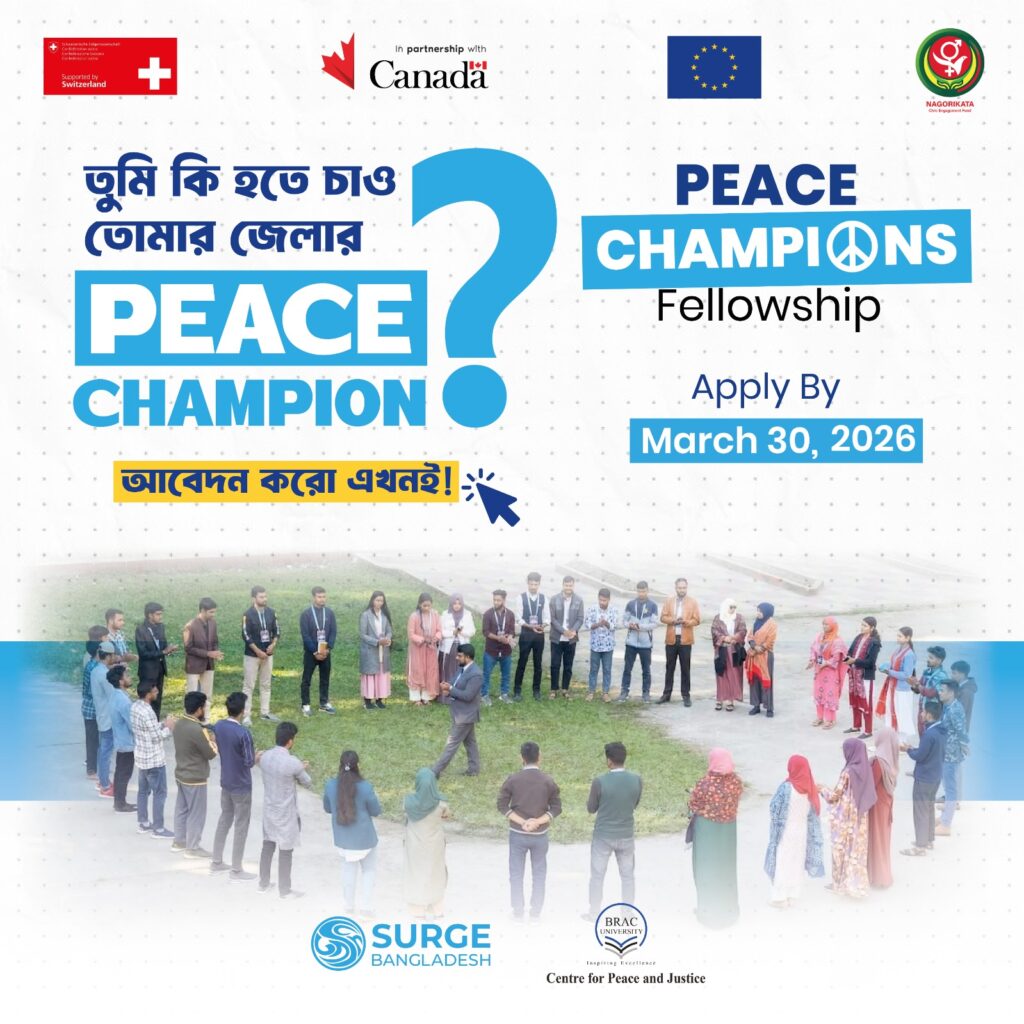
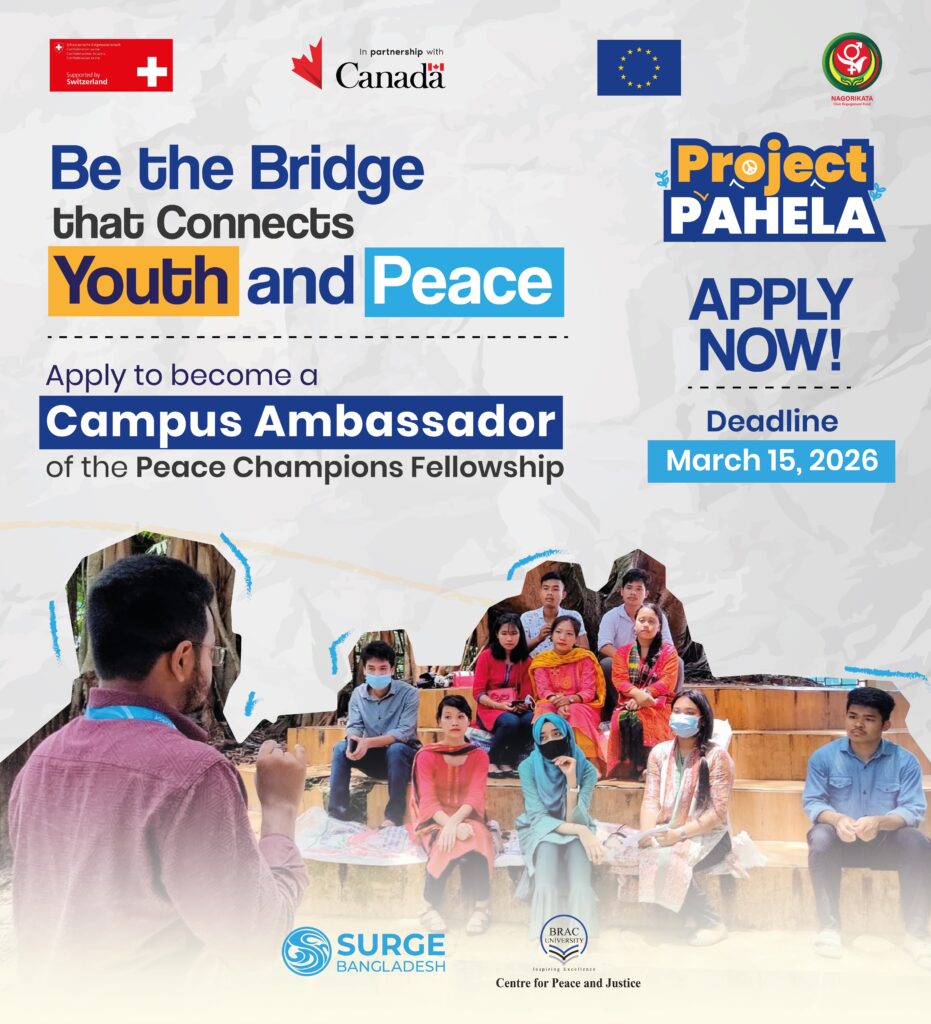
Running from May 2026 to October 2027, this 18-month fellowship will train 120 young leaders from the Chattogram region as Peace Champions. Fellows will complete a certified course on peace, meaningfulness, and research methodology, establish district-level Peace Cafés, conduct focus group discussions, and collect field data to contribute to the Chattogram Peace and Meaningfulness Index (CPMI). Through advocacy events, community action projects, and policy dialogue, fellows will promote peaceful coexistence, interfaith harmony, and social cohesion. The fellowship combines leadership development, field research, and grassroots action, empowering young people to design evidence-based, inclusive solutions that strengthen peace, justice, and community resilience.
This initiative is supported by the Nagorikata: Civic Engagement Fund (CEF) Programme, managed by GFA Consulting Group and supported by the Switzerland Embassy, the Canadian Embassy, and the European Union.
Fellowship Objectives
The fellowship aims to:
- Develop young peace leaders at the district level
- Promote ethical leadership and social responsibility
- Promote peaceful coexistence and social harmony
- Support the establishment of district-level Peace Cafés
- Encourage youth-led local solutions
- Strengthen research knowledge and analytical understanding among youth
- Support interfaith and intercultural engagement
- Promote evidence-based advocacy and local leadership networks
Why This Fellowship Matters
Many young people have leadership potential but limited access to structured opportunities that connect learning with real social impact.
This fellowship addresses that gap by creating:
- Inclusive Platforms for Youth Leadership
- Opportunities for critical dialogue
- Research-based learning
- Practical peacebuilding experience
- Community Action Project
Fellowship Duration
Duration: 18 Months
May 2026 – October 2027
The fellowship includes approximately 60 days of direct engagement distributed across the full programme period.
This structure allows fellows to continue academic studies or professional commitments while participating in major programme activities.
Fellowship Structure
The fellowship is organised in multiple stages:
Phase 1: Core Training
Fellows complete a certified training course covering:
- Team building and ethical leadership
- Resilience and community action planning
- Community Action Project (CAP) design and presentation
- Peer engagement, ice-breaking, and collaborative learning practices
- Focus Group Discussion (FGD) methodology and facilitation techniques
- Reflection and community application approach
Phase 2: Peace Café Formation
Fellows establish 11 district-level youth dialogue platforms called Peace Cafés.
These spaces are designed for:
- Youth discussion
- Community reflection
- Dialogue across diversity
- Local peace conversations
Phase 3: Field Research
Fellows conduct:
These spaces are designed for:
- Focus Group Discussions
- Community conversations
- Survey-based field data collection
This supports the development of the Chattogram Peace and Meaningfulness Index (CPMI).
Phase 4: Public Engagement
Fellows will hold district-level events to share FGD and CAP findings with communities and stakeholders using interactive presentations and activities. They will gather feedback, identify local priorities, and build networks for sustainable action. These events promote inclusive participation, community ownership, and lasting peace and social cohesion.
Phase 5: CAP Implementation
Each district will set up a youth-led Peace Café as a hub for dialogue, collaboration, and community engagement. The 11 Peace Cafés will implement 11 Community Action Projects addressing local needs, promoting peace and inclusion. Fellows will facilitate activities, monitor progress, and engage stakeholders to ensure sustainable, positive community impact.
What Fellows Will Learn
Fellows gain practical learning in:
- Four-day Certificate Course on Peace, Meaningfulness, and Research Methodology.
- Practical training on data collection, ethics, and survey methods.
- Hands-on experience conducting Focus Group Discussions (FGDs).
- Leadership and facilitation skill development.
- Community mobilisation and advocacy training.
- Experience working with diverse faith and ethnic communities.
- Participation in refresher workshops and peer learning sessions.
- Exposure to policy dialogue and district-level public events.
- Project design skills through Community Action Project (CAP) workshops.
- Networking with academics, civil society leaders, and policymakers.
Fellowship Activities in Detail
Selected fellows will:
- Attend Residential and Virtual Training
- Engage in Ice-Breaking and Team Building Activities
- Develop Ethical Leadership Skills
- Design Community Action Projects (CAPs)
- Conduct Focus Group Discussions (FGDs)
- Participate in Stakeholder Mapping and Root Cause Analysis
- Document Findings and Reports
Eligibility Criteria
To apply and serve as a Peace Champions Fellow, applicants must meet the following eligibility criteria and commit to full participation in programme activities:
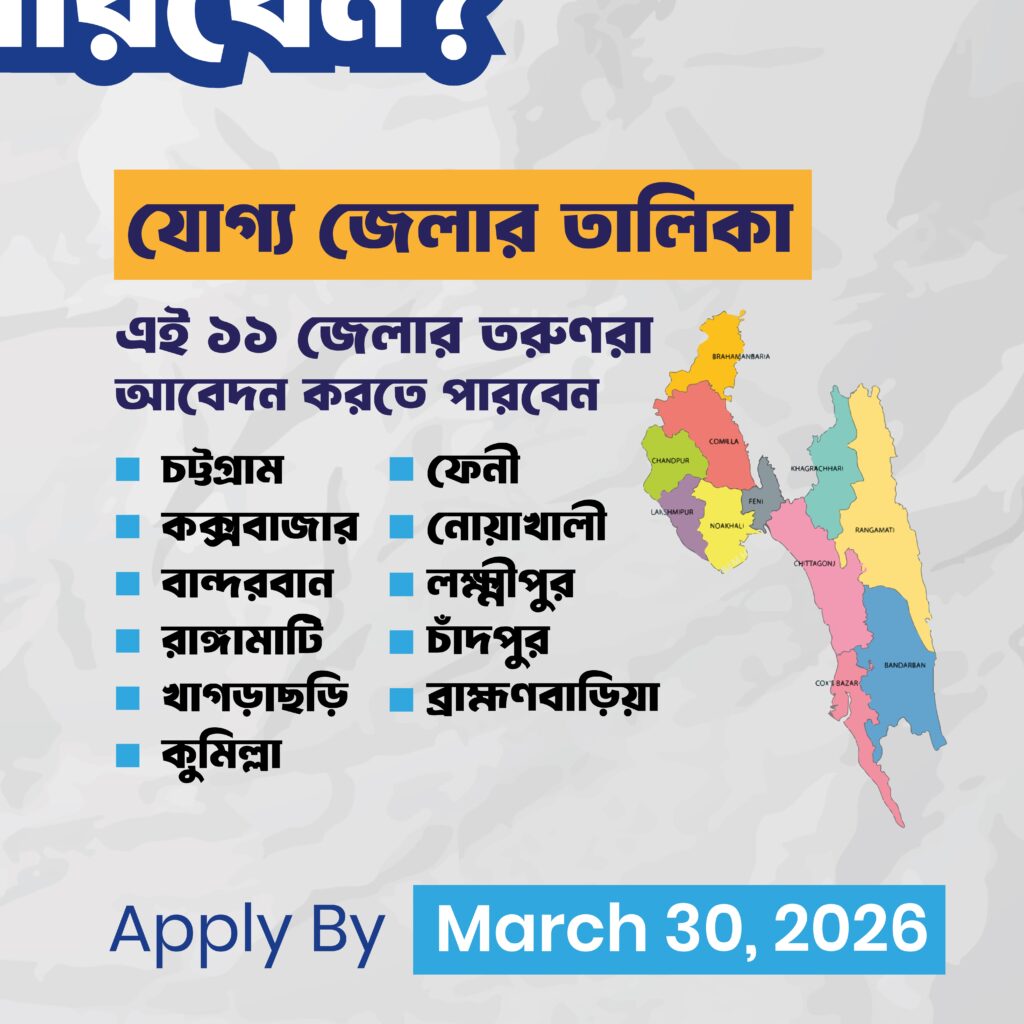
- Residency: Be a resident of one of the following districts and remain there until December 2027: Brahmanbaria, Chandpur, Cumilla, Feni, Lakshmipur, Noakhali, Chattogram, Bandarban, Cox’s Bazar, Khagrachhari, Rangamati.
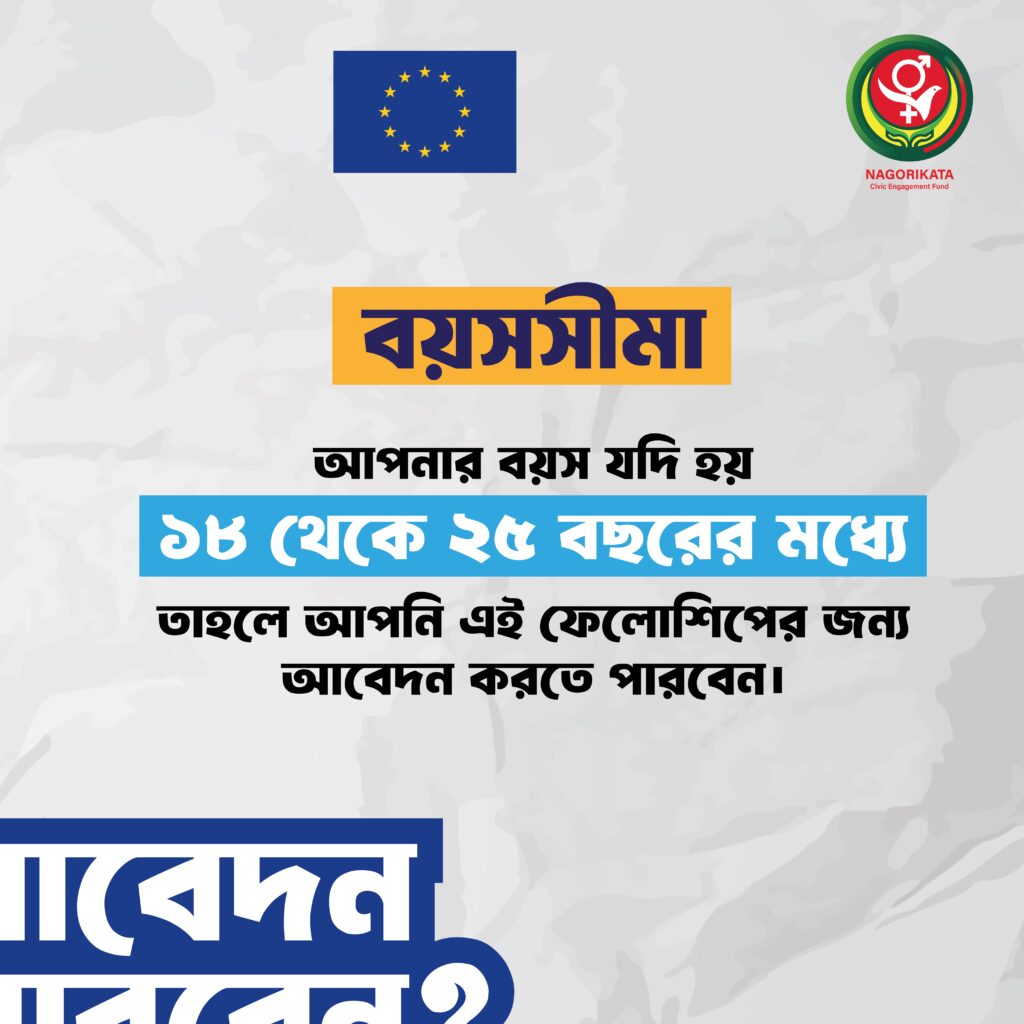
- Age Requirement: Be between 18–25 years old.
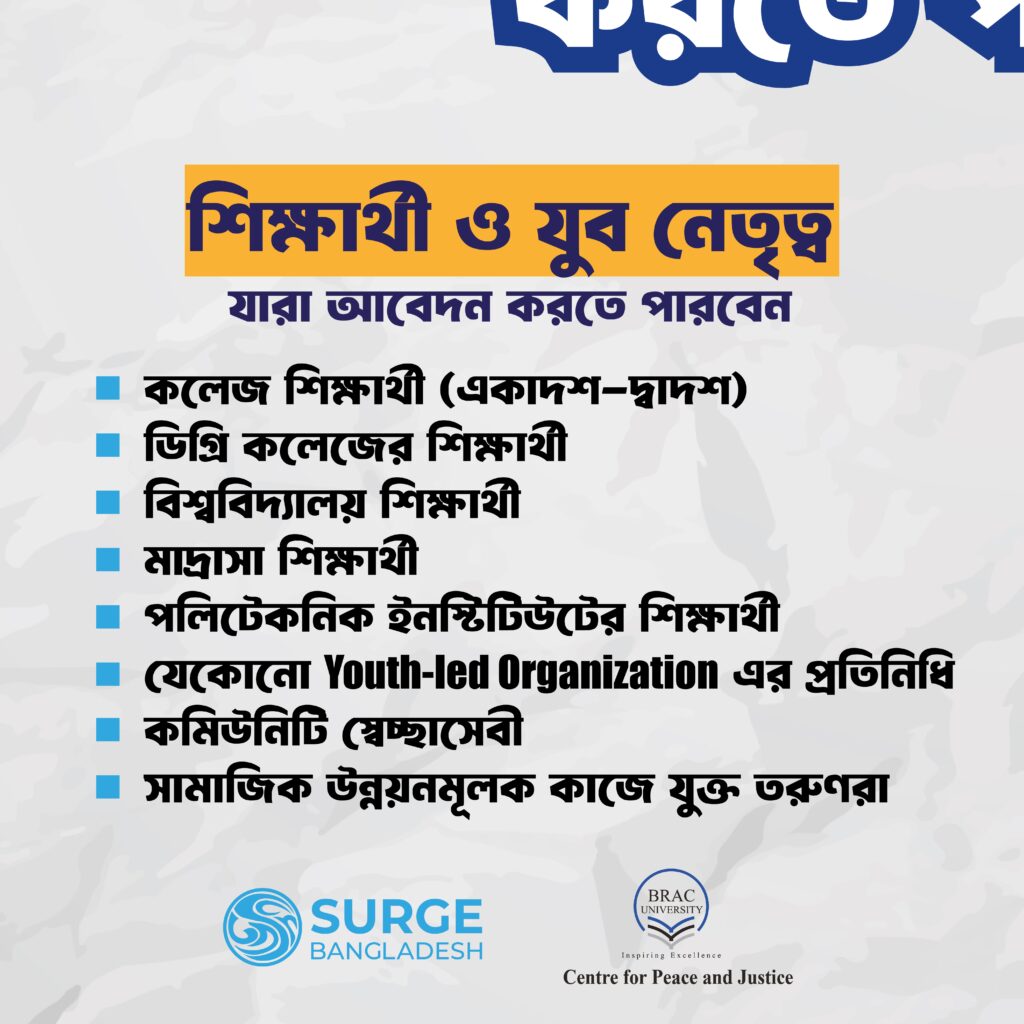
- Educational Background: Be a student from Class 11 to recent graduate level/ (Honours 2nd and 3rd year students are especially encouraged to apply).
- Interest & Motivation: Demonstrate strong interest in peacebuilding, civic engagement, research, and community development.
- Commitment to Inclusion: Show respect for diversity, gender equality, and social harmony. Women, ethnic minorities, and persons with disabilities are strongly encouraged to apply.
- Training Participation: Successfully complete the four-day Certificate Course on Peace, Meaningfulness, and Research Methodology (delivered in two phases).
- Peace Café Formation: Work collaboratively to establish and operate one youth-led Peace Café in each district.
- Research Engagement: Conduct Focus Group Discussions, prepare reports, and collect survey data as a community enumerator.
- Advocacy & Community Action: Organise district-level dissemination events and implement one Community Action Project engaging local communities.
- Full Engagement: Participate in refresher workshops, monitoring and evaluation activities, and attend the Closing Colloquium
Recognition, TA/DA & Financial Support
1. Fully Funded Fellowship: The 18-month fellowship (with 60 days of direct engagement) is fully funded, covering all core programme activities.
2. Travel Allowance (TA/DA): Travel and daily allowances will be provided for two residential trainings and the closing colloquium (for selected fellows).
3. Training Materials & Goodies: Fellows will receive a backpack, T-shirt, notepad, and essential learning materials.
4. Peace Café Grant Support: Small grants will be provided to establish and operate 11 district-level Peace Cafés.
5. Support for FGDs: Financial support will be provided to conduct 22 Focus Group Discussions (FGDs) across 11 districts.
6. Enumerator Honorarium: Fellows will receive an honorarium for conducting research data collection for the CPMI.
7. Community Action Project Funding: Funds will be provided to implement 11 Community Action Projects based on research findings.
8. Certification: All fellows who successfully complete the programme will receive an official Fellowship Completion Certificate.
9. Institutional Collaboration: Fellows will gain the opportunity to work closely with the Centre for Peace and Justice (CPJ), BRAC University, and Surge Bangladesh, expanding their professional network and experience.
Fellowship Timeline
May 2026 – October 2027 (18-month duration with 60 days of direct involvement). The timeline below is tentative and may be adjusted according to project decisions:
| Timeline | Event Title / Activity |
|---|---|
| March 2026 | Application Period |
| April 2026 | Online Interviews and Final Selection |
| May & July 2026 | Four-day Certificate Course on Peace, Meaningfulness, and Research Methodology (conducted in two phases) |
| May 2026 | Group Work: Establish 11 district-based youth-led “Peace Cafés” |
| June & August 2026 | Group Work: Conduct 22 Focus Group Discussions (FGDs) in 11 Peace Cafés (2 FGDs per Café) and prepare 11 brief FGD reports |
| September 2026 | Six-day Virtual Refresher Workshops; Presentation of FGD Reports and Review of Core Certificate Course Concepts |
| November 2026 | Research Data Collection as Enumerator (each Fellow will collect data from 20 individuals) |
| February 2027 | Conduct 11 District-Level Public Events (1 per Peace Café) to disseminate CPMI key findings; reach approximately 500 participants per Café |
| March 2027 | Virtual Project Development Workshops for preparation of CAP (Community Action Projects) |
| April – June 2027 | Implementation of 11 Community Action Projects (minimum 50 community members engaged per Peace Café) |
| December 2027 | Project Closing Colloquium to showcase impact and CPMI findings |